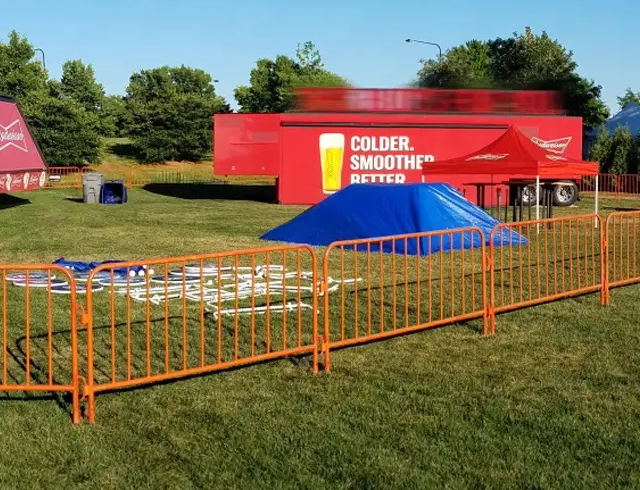
Every construction side, music festival, and public event faces the same challenge: people need to be directed, contained, or kept out. But one the job is done, these barriers must be taken down. That’s exactly where Temporary Fencing comes in.
And not all temporary fence is built the same. The differences lie in the details : how the frames are welded, how the feet are attached, and whether the galvanizing is done before or after welding.
Temporary Fence – also called as portable fences, construction barricade, or event fencing – is a modular, free-standing barrier system, which is designed to be quickly installed, moved and removed without damaging the ground.
Unlike permanent fencing, temporary fencing does not require concrete footings, post holes, or specialized tools. It stands on its own weighted feet and connects panel to panel with simple connectors.
A standard temporary fence panel consists of :
- The outer frame – usually galvanized steel tube
- The vertical uprights – the filling bars welded inside the frame
- The detachable feet – flat, bridge or cross style feet for stability
- The connection hooks – connecting the panels together
From one panel to a mile of barricade, the system scales to fit the job.
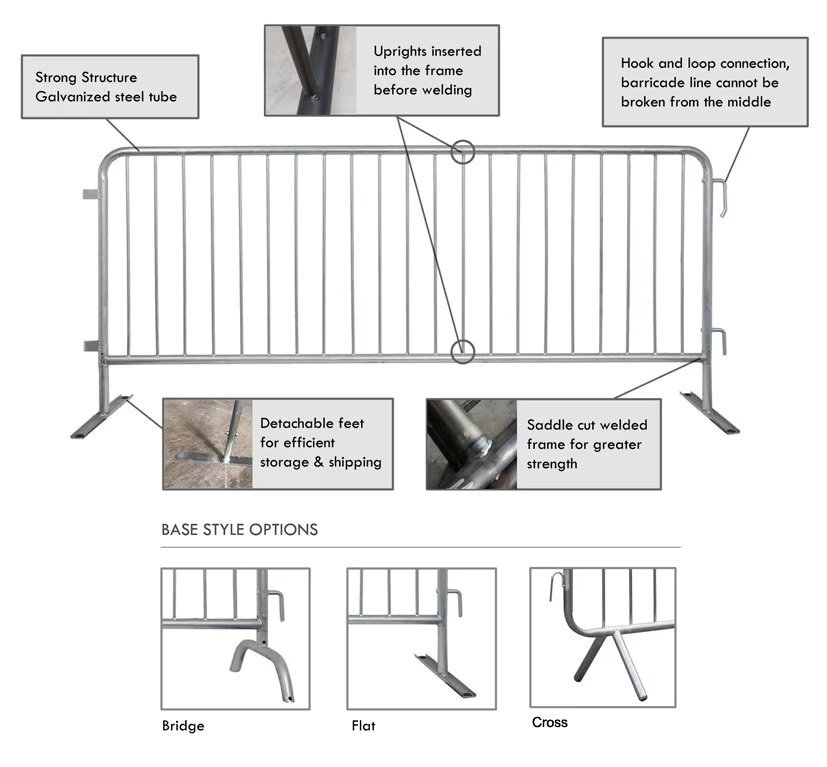
- Strong Structure – Galvanized Steel Tube
The frame starts with galvanized steel tube, it is the genuine hot-dipped galvanization.
This matters because the temporary fence is meant to be outdoors. It gets rained on, dragged thorough muddy ground, stacked on trucks and stored in damp yards. Painted frames would peel off easily and rust once the paint is gone. Galvanized ones won’t.
- Uprights Inserted Into the Frame Before Welding
This is a detail that most buyers nerve see – yet it is one of the most important.
Some factories directly attach the vertical bars to the outside of the frame and weld them on. It’s faster and cheaper. And it creates a weak point that can snap under load.
We insert the vertical bards into the pre-drilled holes in the frame and then weld. The bars pass through the tube, not just touch it. And what this means for you : Panels that survive being thrown off a truck, not panels that come back bent.
- Saddle-Cut Welded Frame
Our frame uses the saddle-cut technique – the tube ends are is contoured to match the curve of the mating tube. The joint fits flush before welding begins. And what this means for you : Corners that don’t crack when the panel is dropped or dragged.
- Hook and Loop Connection
Some system use only a single bolt or pin at each joint. The problem? That connection point is the only thing holding two panels together. If it bends or breaks, the barricade line splits.
Our system uses a hook-and-loop connection. What this means for you: A barricade line that stays intact — even when someone leans on it, a gust of wind hits it, or a vehicle nudges it.
- Detachable Feet
Fixed feet are a shipping nightmare. They take up space, get bent in transit, and make stacking impossible. Our feet detach. What this means for you: Lower shipping costs. Easier inventory. Fewer headaches.
Temporary fence is a simple product, but we are not fabricated it in a simple way. Welding before galvanizing, saddle-cut frames & inserted uprights, we are doing our way to build it actually worth buying.